A paper describing a seafloor survey of a Greenland glacial fjord using our "LoggLaw CAM" system has been published in PLOS ONE.
An international research team led by Evgeny A. Podolskiy of Hokkaido University’s Center for Arctic Research, along with an international research team, published the results of synchronized video and acoustic observations conducted on the seafloor of a glacial fjord in northwestern Greenland using our underwater video logger, “LoggLaw CAM,” in the international academic journal PLOS ONE (May 6, 2026).From the behavior of deep-sea shrimp and copepods to backward-drifting fish of the family Scorpaenidae and even the acoustic presence of narwhals, the study reveals the ecosystem of the glacial fjord seafloor—a scene that had previously been difficult to observe.
Publication details: Podolskiy EA, Ogawa M, Hasegawa K, Tomiyasu M, Sugiyama S, Mitani Y. (2026) Seafloor video-acoustic monitoring in a Greenlandic glacial fjord records hyperbenthos, backward-swimming fish, and narwhals. PLOS ONE. https://doi.org/10.1371/journal.pone.0347193
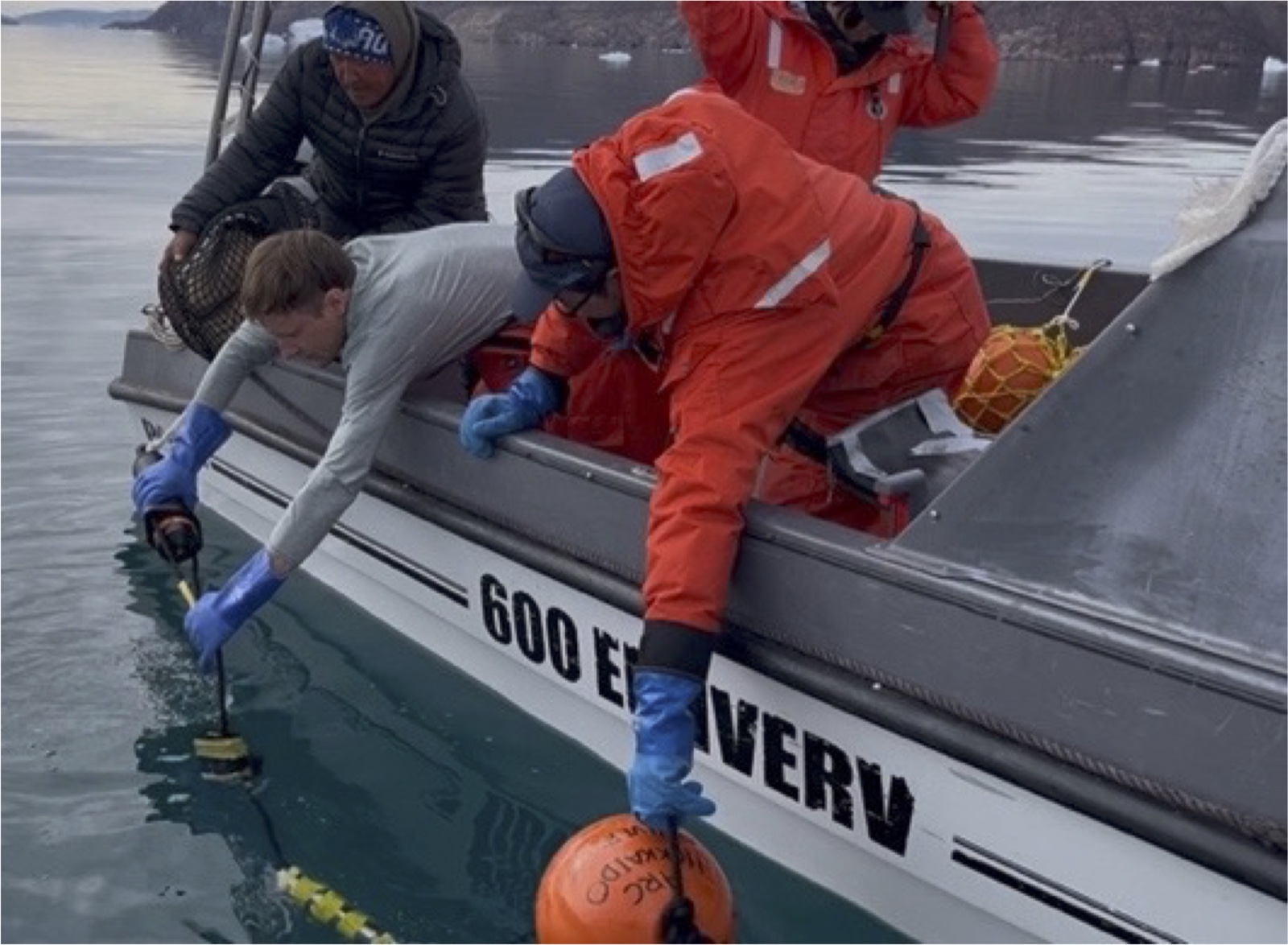
Survey Overview
The survey was conducted in August 2025 in the Inglefield Bredning Fjord in northwestern Greenland (near 77°28′ N, 66°21′ W).The research team deployed a compact mooring system—comprising a LoggLaw CAM, an acoustic recorder (SoundTrap ST600), and ocean environmental sensors—on the seafloor at a depth of approximately 260 m between the Qeqertaq and Heilprin glaciers for about 8 days.With a compact configuration consisting of a single transport case and a total weight of less than 15 kg, the system enabled operations in polar field settings where access by helicopter or boat is essential.
Key Findings
- A total of 478 individuals belonging to more than 11 taxonomic groups were identified—visual analysis of 37 hours of video footage revealed that amphipods (47%) and copepods (26%) were the dominant groups.This provided valuable data as an example of continuous observation of hyperbenthos on the seafloor of a glacial fjord.
- “Backward swimming” by fish of the family Gobiidae was recorded—video captured the rare behavior of these fish passively drifting backward while yielding to currents near the seafloor.
- Acoustic presence of narwhals detected throughout the entire period—Synchronously recorded underwater sounds indicated that narwhals continuously visit the deep parts of the fjord during the summer.
- Tidal-synchronized fluctuations in particle flux—Analysis using Digital Particle Image Velocimetry (DPIV) quantified that particle transport modulates on a cycle of approximately 12 hours.
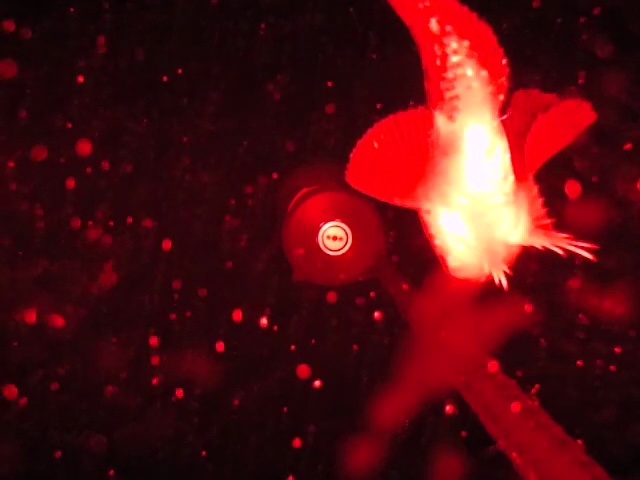
The Role of the LoggLaw CAM
The “LoggLaw CAM” used in this study is an underwater video logger equipped with red LED (wavelength ~660 nm) lighting—which minimizes the impact on deep-sea animals—and hydrophone-synchronized audio recording.In this study, a model rated for depths of 500 m was used to synchronously record 10-minute segments of VGA (640 × 480 pixels, 30 fps) video and 96 kHz audio data every 20 minutes.
It is well known that trawl nets and sediment samplers, which have traditionally been used in seafloor ecological surveys, make it difficult to capture the behavior of highly mobile animals, and that the sampling process itself affects animal communities.Since LoggLaw CAM enables long-term continuous observation in a passive and non-invasive manner, this paper positions it as an “alternative methodology for ecological surveys in the deep glacial fjords.”
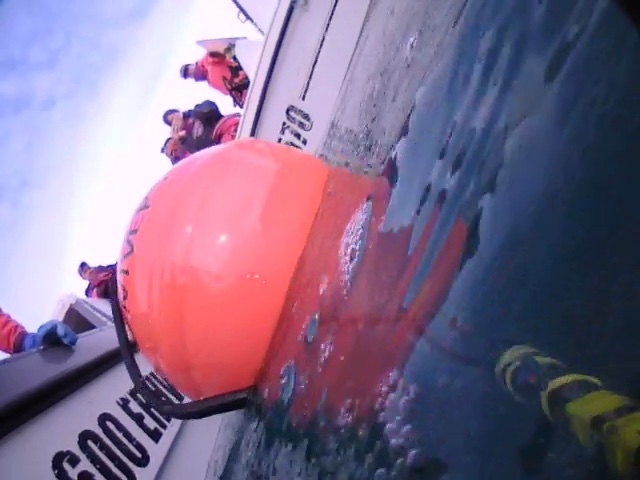
Significance and Future Developments
This paper represents a rare example of synchronized observations of video, acoustic, and physical parameters—all accomplished using a single set of compact equipment—in the challenging observational environment of a polar glacial fjord.This demonstrates that our line of underwater logger products can contribute to international research projects focused on monitoring polar coastal ecosystems, where the effects of climate change are particularly pronounced.
We will continue to develop and provide solutions for acquiring video, acoustic, and behavioral data tailored to polar, deep-sea, and coastal environments, and we will contribute to the understanding and conservation of marine ecosystems in collaboration with research institutions both in Japan and abroad.
Co-authors
- Evgeny A. Podolskiy (Hokkaido University, Arctic Research Center) — Lead Author and Corresponding Author
- Monica Ogawa (Hokkaido University, Center for Arctic Research / National Institute of Polar Research)
- Kohei Hasegawa (Hokkaido University, Graduate School of Fisheries Sciences)
- Makoto Tomiyasu (Hokkaido University, Graduate School of Fisheries Sciences)
- Shin Sugiyama (Hokkaido University, Institute of Low-Temperature Science)
- Yoko Mitani (Kyoto University, Wildlife Research Center)
Supplementary Materials (PLOS ONE Supplementary Materials)
As supplementary materials for this paper, PLOS ONE has published a compilation of highlights from footage captured by LoggLaw CAM, videos of the analysis process, and an annotation table of all detected organisms. These can be downloaded directly from the links below.
- S1 Video — Videos of Organisms (MOV): A compilation of highlights featuring organisms that passed through the camera and synchronized audio clips when they were detected.
https://doi.org/10.1371/journal.pone.0347193.s001 - S2 Video — Automatic Image Processing (MOV): A frame-by-frame demonstration of the automatic image processing procedure that calculates the number of particles, covered area, and average luminance.
https://doi.org/10.1371/journal.pone.0347193.s002 - S3 Video ― PIV Processing (MOV): An example of digital particle image velocimetry (DPIV) analysis
0049*.MOV
https://doi.org/10.1371/journal.pone.0347193.s003 - S1 Table — Table of Detections (CSV): An annotation table of all detected organisms.
https://doi.org/10.1371/journal.pone.0347193.s004 - S1 Figure — Periodograms (PDF): Periodic analysis of particle coverage area, particle count, and red luminance (with 95% confidence intervals).
https://doi.org/10.1371/journal.pone.0347193.s005
Related Products and Services
LoggLaw CAM — Underwater Video Logger
The LoggLaw CAM used in this study is an underwater video logger equipped with red LED lighting and synchronized hydrophone recording. It is widely used for recording the natural behavior of marine animals, conducting observations in low-light and pitch-black environments such as the deep sea and glacial fjords, and for non-invasive monitoring of ecosystems.
What Is Bio-logging? — Explanatory Page
Bio-logging is a technique in which small data loggers are attached to animals to record behavioral, physiological, and environmental data. This page explains examples of how our products are used and provides an overview of global research trends.