Collar-type Wildlife GPS

LoggLaw G2C

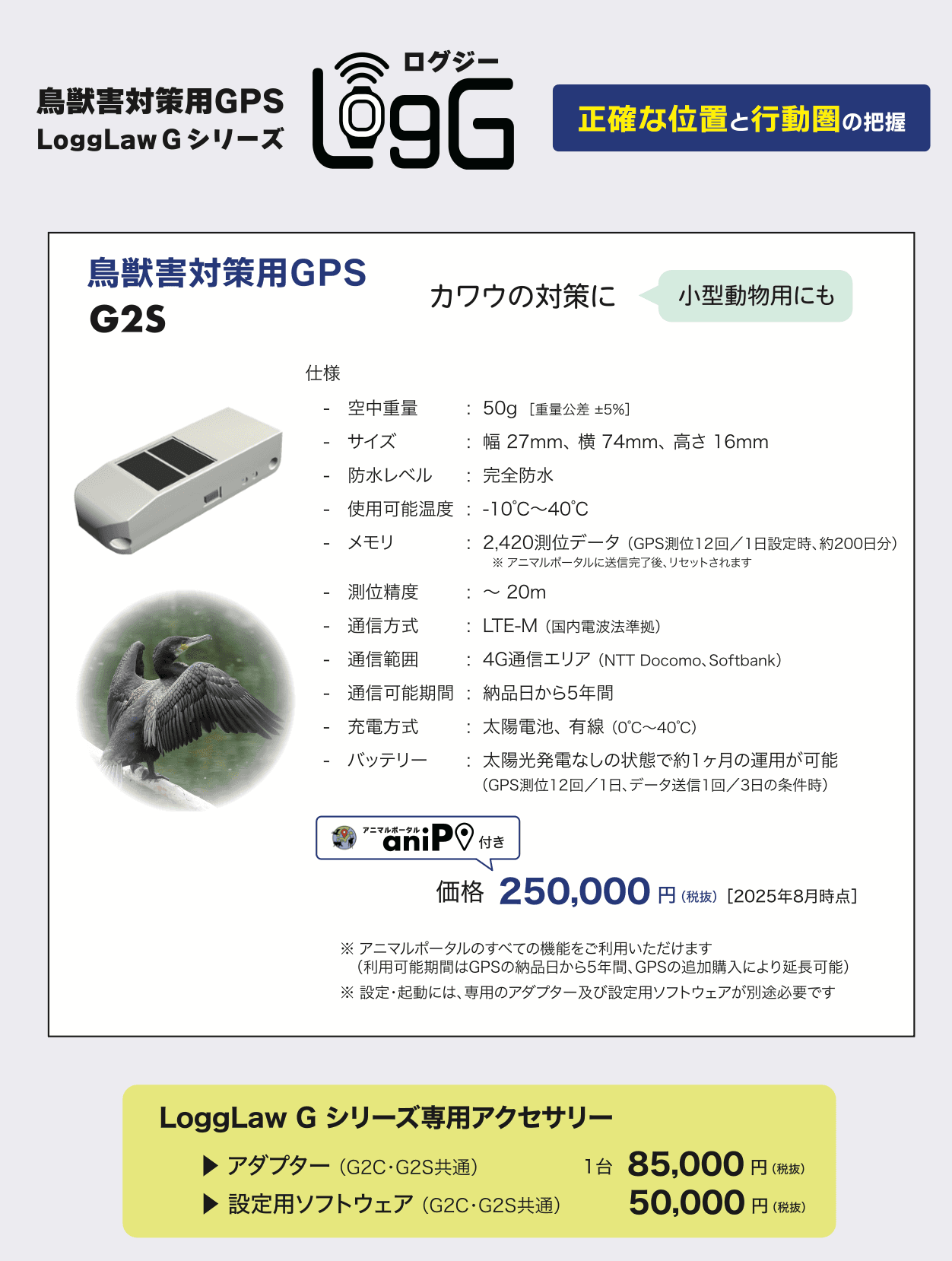
GPS collar with LTE-M communication and solar charging. Real-time monitoring of monkeys, deer, bears, and more. Widely adopted by municipalities and research institutions for wildlife management.

What is a GPS Collar?

A GPS collar is a wildlife tracking device worn around an animal's neck, combining a GPS / GNSS receiver with communication hardware. It continuously records position data via satellite positioning and transmits or stores the data to reveal home ranges, movement paths, and activity patterns objectively.

Unlike visual observation or VHF radio telemetry, GPS collars enable long-term continuous behavioral data collection, supporting wildlife management, damage prevention, and conservation research.

GPS Collar vs. VHF Collar

Conventional VHF collars only transmit a radio signal; locating the animal requires a field operator to triangulate it on-site. A GPS collar records latitude and longitude directly via satellite positioning. Models with built-in cellular connectivity — such as the LoggLaw G Series using LTE-M — automatically upload data to the cloud for near-real-time remote monitoring.

Key Features

LTE-M Communication

Energy-efficient LTE-M communication enables real-time position data transmission over a wide coverage area.

Solar Charging

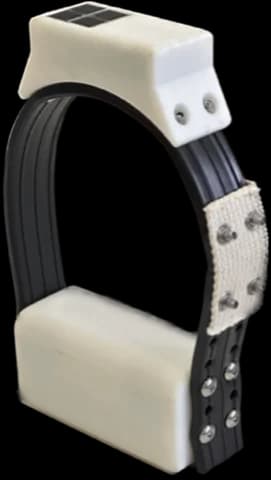
Built-in solar panel for worry-free long-term operation without battery replacement. Maintenance-free.

Long-Life Design

High-efficiency power management combined with solar charging enables years of continuous operation.

Rugged Enclosure

Robust design that withstands harsh environments and vigorous movements of wild animals. IP67 waterproof rated.

Real-Time Monitoring

Check animal locations anytime, anywhere via the dedicated app or web dashboard.

Geofencing

Automatic detection of area entry/exit. Useful for wildlife damage prevention and conservation efforts.

Applications by Target Species

The LoggLaw G Series is a GPS collar designed for medium-to-large terrestrial mammals. Representative applications are shown below.

GPS Collar for Monkeys (Japanese Macaque Troop Tracking)

Used for tracking Japanese macaque troop home ranges, studying seasonal migration, and evaluating the effectiveness of deterrence measures. Long-term winter monitoring of macaque behavior using LoggLaw G2C has been conducted.

GPS Collar for Deer (Home Range Study, Forestry & Agricultural Damage Prevention)

Used for mapping sika deer home ranges, identifying wintering grounds, and analyzing incursion patterns into farmland and forests. In March 2026, LoggLaw G2C was deployed in a study that documented the first confirmed overwintering of sika deer in Kamikochi, reported in the Shinano Mainichi Shimbun.

GPS Collar for Bears (Asian Black Bear Monitoring)

Used for tracking Asian black bears and detecting approach to villages and human activity zones. Combined with geofencing, the system automatically issues alerts when an animal enters a designated area, enabling early warning and response.

Case Study

Read our news article on the deployment of LoggLaw G2C in a sika deer overwintering study in Kamikochi.

Read the news article
LoggLaw G2C

Gallery

View actual product images and usage photos.

* Product images may differ from the actual product. Specifications are subject to change without notice for improvement purposes.

Specifications

Detailed Technical Specifications

GPS Specifications

Positioning MethodGPS / GNSS
Positioning Accuracy~20m
Position Fix IntervalConfigurable

Communication Specifications

StandardLTE-M (Cat-M1)
Transmission IntervalConfigurable
AntennaBuilt-in
Coverage Area4G coverage (NTT Docomo, Softbank)

Body Specifications

Waterproof RatingFully waterproof
Operating Temperature-10°C ~ 40°C
Weight316g (monkey model) / 345g (deer model)

* Specifications are subject to change without notice for improvement purposes.

Choosing a GPS Collar

The right GPS collar depends on the research objective, target species, and operational timeframe. This section compares GPS and VHF collars and outlines key factors to consider when selecting a product.

VHF Collar vs. GPS Collar

ComparisonVHF CollarGPS Collar (LoggLaw G)
Position acquisitionEstimated via radio triangulationDirect latitude/longitude via satellite positioning
Real-time availabilityOnly during on-site trackingNear real-time via LTE-M
Field workOperator must carry a receiver and triangulateRemote data retrieval after deployment
Data volumeSparse point observationsContinuous movement tracks
Long-term operationRequires battery replacementSolar charging enables multi-year operation

Key Selection Factors

Target Animal Size and Neck Circumference

Choose a collar with appropriate size and weight for the target animal's body. For animal welfare reasons, the ratio of collar weight to body weight should be considered carefully.

Communication Method and Operating Area

The LTE-M network used by the LoggLaw G Series covers roughly the same area as standard mobile phone service. In deep mountain areas outside coverage, stored data can be batch-transmitted when the animal re-enters the network.

Operational Duration and Power Source

The choice of power source depends on whether the study spans months or years. Solar-charged models are effective for long-term operation.

Integration with Animal Portal

Data collected with the LoggLaw G Series integrates with Animal Portal, a cloud platform for wildlife damage management and municipal operations. It provides map-based home range visualization, geofencing, proximity alerts, and simultaneous tracking of multiple individuals — covering the essentials for field operations.

LoggLaw G Series / GPS Collar FAQ

Which species does the LoggLaw G Series support?
The LoggLaw G Series targets medium-to-large terrestrial mammals. It has been deployed on Japanese macaques, sika deer, and Asian black bears. Contact us for recommendations on specific species or body sizes.
How long does the battery last?
Approximately one year of operation is possible on battery alone, without solar charging (under conditions of 12 GPS fixes per day and 1 data transmission per day). With solar panel charging, continuous operation can be extended significantly. Actual runtime depends on individual animal behavior and sunlight conditions.
Can position and transmission intervals be configured?
Yes. Both positioning and data transmission intervals can be configured for your study objectives — high-frequency tracking for detailed behavioral analysis, or energy-efficient settings for long-term monitoring.
Do animals need to be recaptured to retrieve the collar?
Position data is transmitted remotely over LTE-M, so recapture is generally not required for data retrieval. The collar belt uses a cotton-based material that naturally deteriorates, and the collar is expected to detach on its own after approximately 2 to 3 years. An active drop-off mechanism (electrically triggered release) is not included.
What is the communication coverage area?
The LTE-M coverage area is roughly equivalent to standard mobile phone coverage. In non-coverage regions, stored data can be batch-transmitted when the animal re-enters coverage.
Can multiple individuals be tracked simultaneously?
Yes. Each device has a unique ID, and the cloud platform visualizes and compares the movements of multiple individuals simultaneously.
In what formats can data be exported?
Data can be exported in standard formats including CSV, KML, and GeoJSON, enabling straightforward integration with GIS and analysis tools.
Is Animal Portal integration required?
The LoggLaw G Series is primarily operated in combination with Animal Portal. Collected data can also be exported in standard formats such as CSV, KML, and GeoJSON, enabling use with existing GIS environments and analysis tools. We tailor recommendations to each municipality's or research institution's operational setup — please contact us for details.

Inquire About LoggLaw G2C

For detailed product information, pricing, case studies, and more, feel free to contact us. Our expert staff will propose the best solution for your needs.