Home range
Mapping troop home range
Fit 1–2 individuals per troop, and the seasonal and annual home range emerges as a map. Use it as base data for damage-management and capture planning.
Track macaque troops in real time, at the precision deterrence and early warning need.
Fit one or two animals in a troop and you can infer the home range of the whole group. The LoggLaw G2C monkey model gives municipalities the data to predict where macaques will appear and to check whether deterrence actually worked, rather than relying on sightings and hearsay.
A dedicated monkey model sized for Japanese macaque body conformation and behavior. The cotton collar strap degrades naturally and drops off within 2–3 years, so no recapture is required for retrieval.
Built-in solar charging minimizes the need to re-capture macaques for battery service. LTE-M sends data directly over the cellular network nationwide.
To capture troop movement immediately after deterrence operations, the device can be remotely switched to a high-frequency mode of up to 2-minute GPS fixes and 5-minute uploads.
A GPS collar for Japanese macaque (Macaca fuscata) is a tracking device worn on the neck that logs latitude and longitude via satellite positioning and uploads data over a cellular network. Unlike VHF telemetry, which requires an operator on site to triangulate signals, a GPS collar enables continuous, remote tracking of troop range, movement, and appearance patterns.
Because Japanese macaques live in cohesive troops, fitting one or two individuals in a troop yields a strong estimate of the whole troop's movement. Applications include resident-notification systems, deterrence-effect evaluation, early warning ahead of damage, and analysis of seasonal movement.
What follows covers the monkey model's specifications, how real tracks look on the map, the field scenarios municipalities use it for, and where it is deployed across Japan.
Damage caused by Japanese macaques is hard to address without understanding troop behavior. GPS collars address questions that visual surveys and resident interviews cannot.
Macaque troops range over several to tens of square kilometers. A GPS collar reveals which settlements, farmland, and forests the troop uses, and when and how often.
Accumulated tracking data reveals temporal, seasonal, and spatial appearance patterns. Once a troop is detected approaching a settlement, residents and farmers can be notified early to prevent damage.
Compare troop behavior before and after deterrence operations such as fireworks, monkey-dogs, and electric fences. The data answers "did it work, how long until they returned, and how did their route change?" with objective evidence.
When several troops coexist in a municipality, fitting one collar per troop lets you identify which troop is responsible for which area, and prioritize capture and deterrence accordingly.
The LoggLaw G2C comes in dedicated monkey and sika deer models. The monkey model is sized for Japanese macaque body conformation and behavior. Attachment method and the collar-to-body-weight ratio require careful evaluation from an animal-welfare standpoint, and we advise on deployment based on the specific operation.
| Monkey model weight | 316g (including collar strap) |
|---|---|
| Target species | Japanese macaque (Macaca fuscata) |
| Communication | LTE-M (Cat-M1) / NTT Docomo & Softbank 4G coverage |
| Positioning | GPS / GNSS (~20m accuracy) |
| Power | Built-in solar; ~1 year without solar input (under 12 GPS fixes/day, 1 transmission/day) |
| Transmission interval | Default several times/day; remotely switchable down to 2-minute GPS fixes / 5-minute uploads |
| Waterproof / Temperature | Fully waterproof / -10°C to 40°C |
| Collar strap | Cotton (degrades naturally over 2–3 years; drops off the animal) |
Real tracks from Japanese macaque troops fitted with LoggLaw G2C GPS collars. Data is automatically uploaded over LTE-M and visualized as home range, routes, and appearance frequency on Animal Portal.
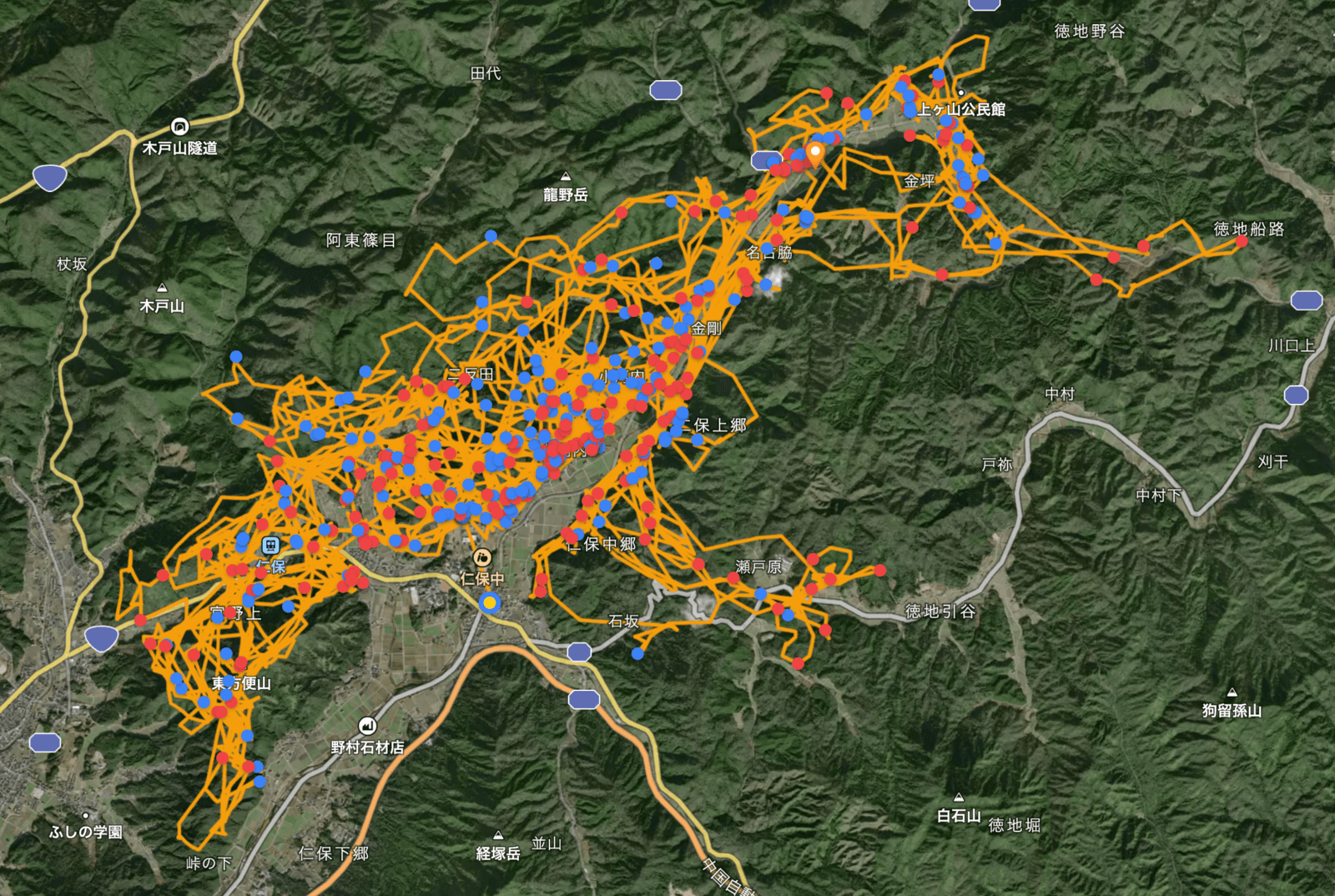
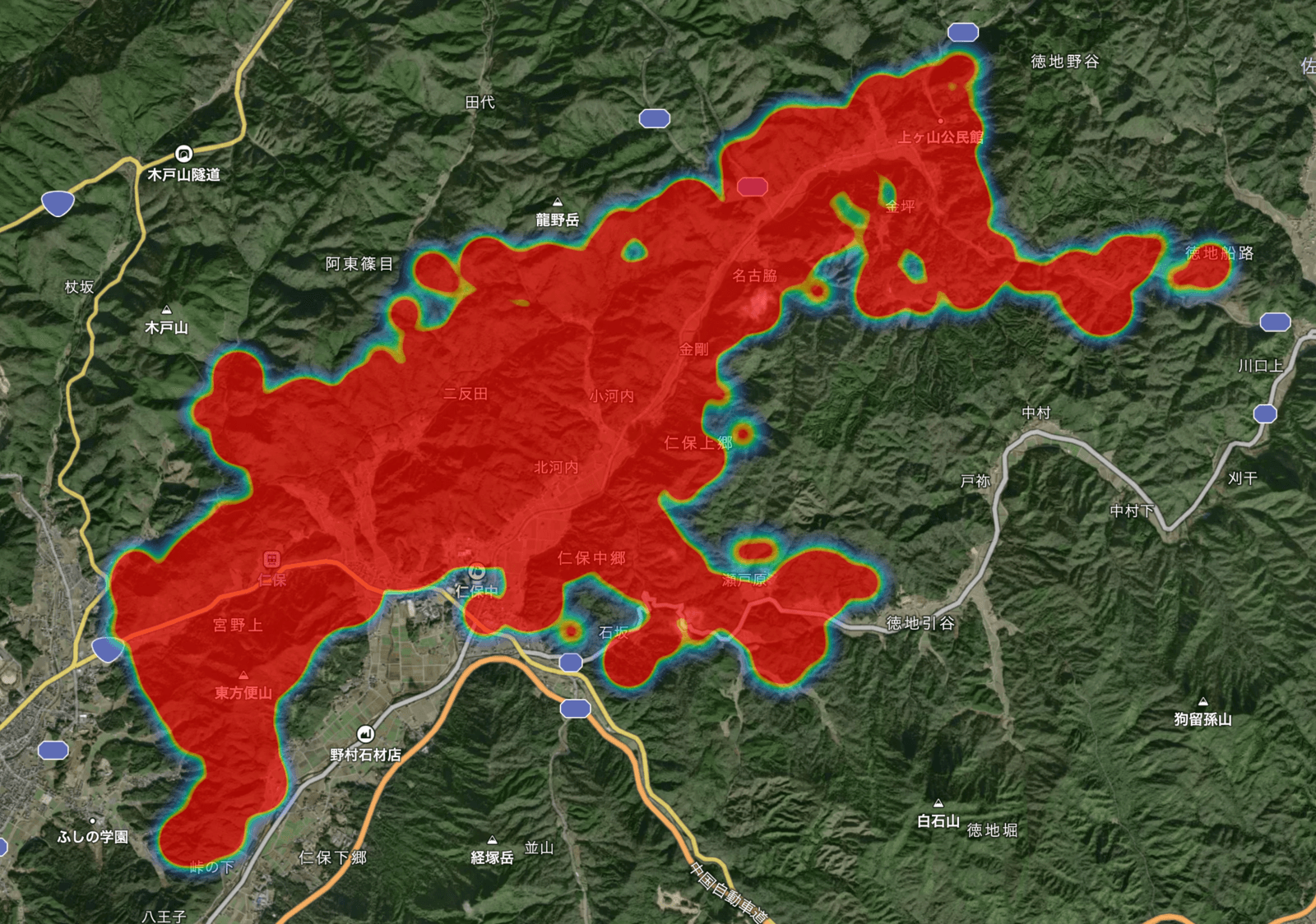
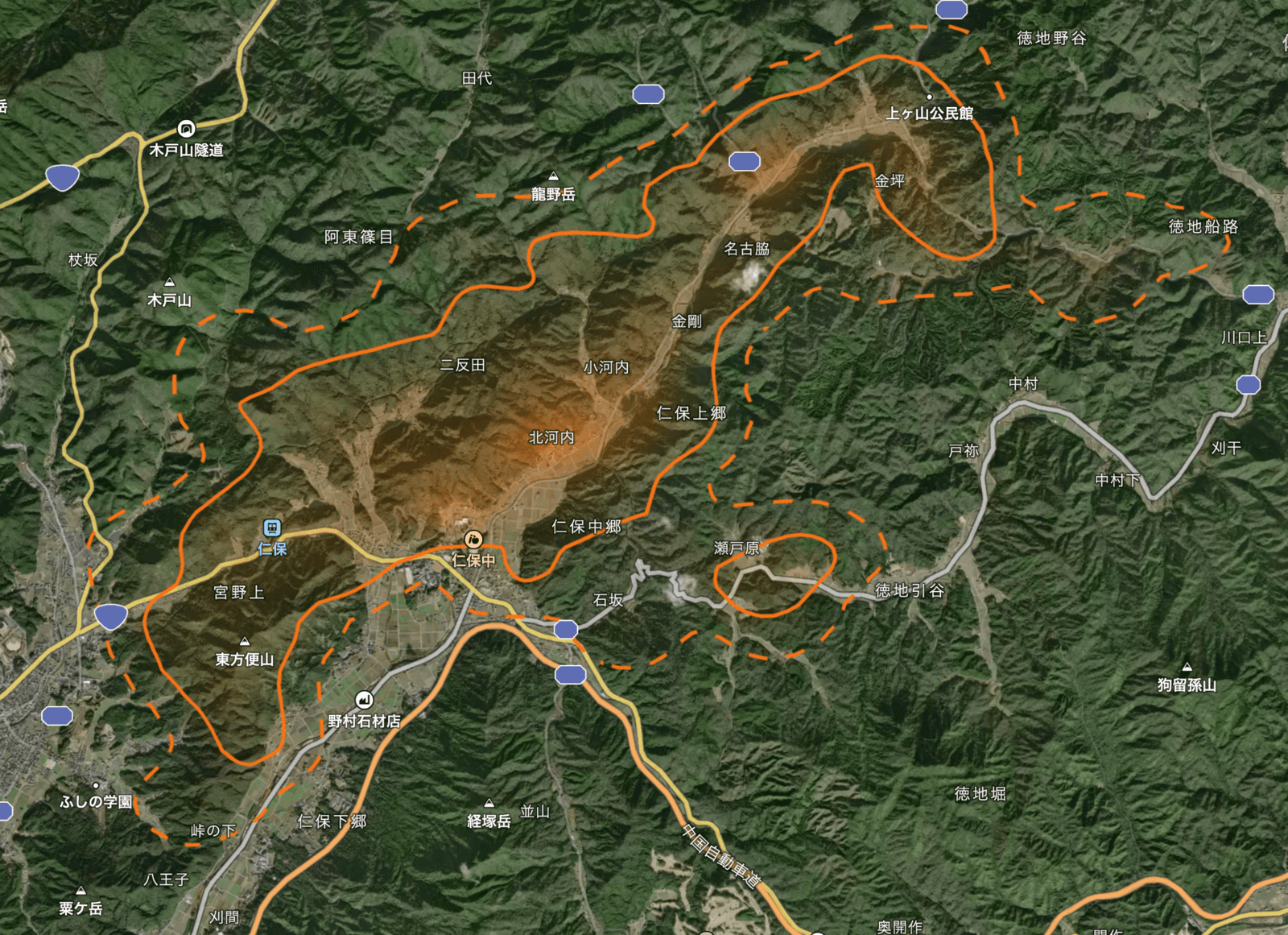
Representative use cases of the LoggLaw G2C monkey model in municipal and research deployments.
Fit 1–2 individuals per troop, and the seasonal and annual home range emerges as a map. Use it as base data for damage-management and capture planning.
Register the locations you want to protect (homes, fields, settlement boundaries) on Animal Portal, and a Proximity Alert auto-emails the user when a troop reaches three distance bands (Critical 300m / Warning 600m / Caution 1,000m). No collar-side configuration is required, so the workflow applies instantly to every individual already deployed. (Polygon-area Geofence alerts for entry / exit detection are in beta.)
Before and after deterrence operations such as fireworks, monkey-dogs, and electric fences, switch to the high-frequency mode (2-minute GPS fixes / 5-minute uploads) and objectively evaluate troop behavior change: re-intrusion time, route shift, dwell change.
Annual data reveals seasonal movement routes such as wintering grounds and summer high-elevation use, supporting prediction and proactive measures ahead of damage periods.
Fit collars on multiple troops in a municipality to identify each troop's behavior and area. Animal Portal visualizes them simultaneously, helping prioritize response.
The collar is also used in research collaborations on macaque troop structure, seasonal behavior, and responses to anthropogenic disturbance. As a Kyoto University-affiliated manufacturer, we support consultations from the study design stage onward.
GPS collars for macaque vary significantly in operational feel depending on the communication scheme. The criteria below matter most for macaque management.
| Criterion (for macaque ops) | Base-station macaque GPS collar | Direct LTE-M macaque GPS collar (LoggLaw G2C) |
|---|---|---|
| Wide-ranging troop tracking | Data gaps outside base-station range | Continuous capture across LTE-M coverage |
| Post-deterrence behavior | Fixed transmission intervals on most models | Remote switch to 2-minute fixes / 5-minute uploads |
| Re-capture burden (power) | Re-capture required at battery end-of-life | Built-in solar minimizes re-capture |
| Operator infrastructure | Local base station, power, maintenance | Cloud only; no field infrastructure |
| Resident notification | Real-time constraints | Real-time sharing and multi-individual management |
| Subsidy (Japan) | Varies by product | Wildlife Damage Prevention Comprehensive Subsidy eligible |
* The comparison above describes general characteristics of the two communication designs and is not exhaustive of any specific vendor's product.
The LoggLaw G2C is currently deployed across 33 prefectures and 85+ municipalities, research institutions, and companies, with a substantial track record on Japanese macaque damage management and behavioral research.
Eligible under the Japanese Ministry of Agriculture, Forestry and Fisheries' Wildlife Damage Prevention Comprehensive Subsidy program. Based on the municipal damage-prevention plan, costs for the LoggLaw G2C macaque collar may be covered by the subsidy. Please contact your municipal office or local agricultural office for details.
Data from the LoggLaw G2C is visualized on Animal Portal: map-based visualization, KDE home-range calculation, simultaneous management of multiple troops, sighting-information sharing, and capture-report management. A built-in Proximity Alert auto-notifies registered users at three distance bands (Critical 300m / Warning 600m / Caution 1,000m). CSV and GeoJSON export plus PDF reports make integration with existing GIS environments straightforward. Polygon-area Geofence alerts for entry / exit detection are in beta.
Learn more about Animal PortalFull guide to selecting a GPS collar for monkeys, deer, and bears: communication, power, and subsidy use.
Learn moreDetailed specifications for the monkey and sika deer models: communication, power, and waterproof rating.
Learn moreThe operations cloud for macaque GPS collars: map visualization, multi-troop management, sighting sharing, and capture-report management.
Learn moreWe support municipalities and research institutions in tailoring the GPS collar deployment to the target troops, areas, and operations workflow, including subsidy use and field trials. Please get in touch.