Key findings
- 1
Visual analysis of 37 hours of footage recorded 478+ individuals across 11+ taxa — a rare continuous record of glacial-fjord hyperbenthos.
- 2
Documented the unusual passive 'backward swimming' of a snailfish drifting with near-bottom currents.
- 3
Detected narwhal acoustic presence across the entire deployment from the synchronized hydrophone audio, indicating sustained summer use of the deep fjord.
- 4
Digital particle image velocimetry (DPIV) quantified a tide-synchronized (~12 h) modulation of particle flux.
Study overview
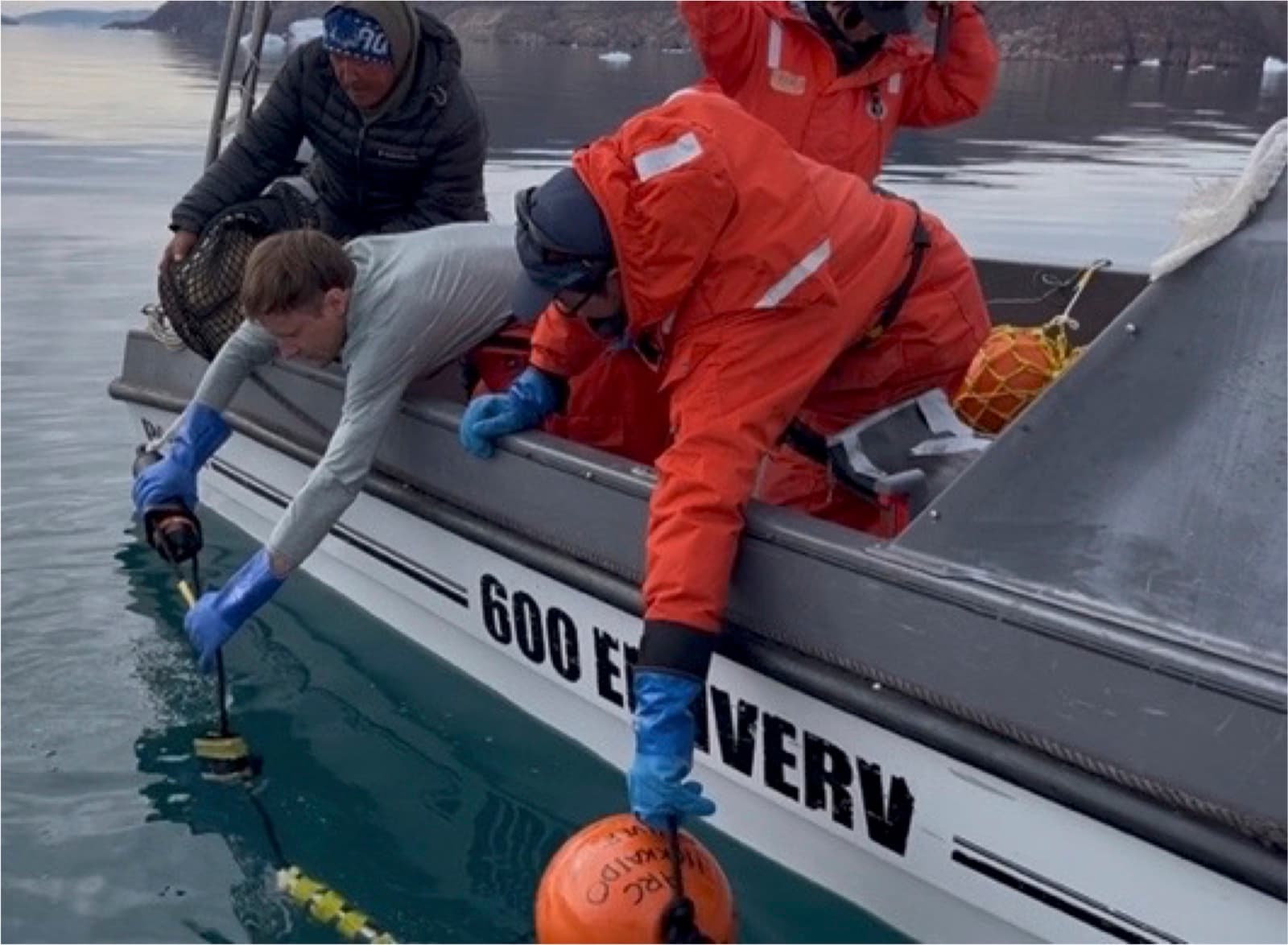
The survey was conducted in August 2025 in Inglefield Bredning fjord, NW Greenland (around 77°28′N, 66°21′W), on the seafloor at ~260 m between the Qeqertaq and Heilprin glaciers.
The team deployed a compact mooring combining LoggLaw CAM, an acoustic recorder (SoundTrap ST600) and oceanographic sensors for ~8 days, recording 10 minutes of VGA (640×480, 30 fps) video and 96 kHz audio every 20 minutes.
The LoggLaw device and its role
The deployment used a 500 m-rated LoggLaw CAM — an underwater video logger with red-LED (~660 nm) lighting that minimizes impact on deep-sea animals, plus synchronized hydrophone recording.
Trawls and grab samplers traditionally used for benthic surveys struggle to capture mobile animals and can themselves disturb the community. Because LoggLaw CAM observes passively and non-invasively over long periods, the paper frames it as an alternative methodology for surveying the deep glacial-fjord ecosystem.
Why it matters
It is a rare case of completing synchronized video, acoustic and physical-parameter observation with a single compact rig in the demanding environment of a polar glacial fjord.
For monitoring polar coastal ecosystems — where climate-change impacts are pronounced — it demonstrates that our underwater loggers can contribute to international research projects.
Authors & collaborators
- Evgeny A. Podolskiy (Arctic Research Center, Hokkaido University) — lead & corresponding author
- Monica Ogawa (Arctic Research Center, Hokkaido University / National Institute of Polar Research)
- Kohei Hasegawa (Faculty of Fisheries Sciences, Hokkaido University)
- Makoto Tomiyasu (Faculty of Fisheries Sciences, Hokkaido University)
- Shin Sugiyama (Institute of Low Temperature Science, Hokkaido University)
- Yoko Mitani (Wildlife Research Center, Kyoto University)
Source
Evgeny A. Podolskiy, Monica Ogawa, Kohei Hasegawa, Makoto Tomiyasu, Shin Sugiyama, Yoko Mitani (2026) Seafloor video-acoustic monitoring in a Greenlandic glacial fjord records hyperbenthos, backward-swimming fish, and narwhals. PLOS ONE.
https://doi.org/10.1371/journal.pone.0347193Related products & use cases
LoggLaw CAM — underwater video logger
Used in this study. Red-LED lighting and synchronized hydrophone recording for non-invasive monitoring in low-light and dark environments.
What is biologging — principles, history, applications
A systematic explainer of how each device type works and the kinds of data they capture.
Related research
Digest by
A graduate of Kyoto University's Graduate School of Informatics and UC Santa Cruz's School of Environmental Studies. As co-founder of Biologging Solutions Inc., a Japan-based biologging equipment manufacturer, he oversees deployments of the company's products with municipalities, universities, and international consortia.
A biologging researcher with field experience including gyro-logger studies of penguin behavior in Antarctica. As co-founder of Biologging Solutions Inc., he leads the development of compact data loggers, GPS collars, and video loggers built directly around real-world research needs.