[Press Release] Turning Unknown Underwater Sounds into a New Observation Target | Proposing “DGPU,” a Circular Framework for Underwater Acoustic Monitoring
Aiming to create a “stethoscope for the ocean” that turns unknown sounds into observations, the company integrates AI-driven candidate screening with expert evaluation into a single process
On October 8, 2026, our company issued a press release titled “Turning Unknown Underwater Sounds into New Observation Targets: Proposing ‘DGPU,’ a Circular Framework for Underwater Acoustic Monitoring” via PR TIMES.We are pleased to announce that research findings on underwater passive acoustic monitoring by Takuji Noda and Takuya Koizumi of our Logverse division were published online in the international academic journal *Scientific Reports* on October 2, 2026.
Full text of the press release: https://prtimes.jp/main/html/rd/p/000000009.000114250.html
Background of the Research
Long-term observations using underwater microphones record a vast and diverse array of sounds, including animal calls, ship noise, waves, and rain. The marine environment varies by region and season, and even for the same sound source, the characteristics of the recorded sound change depending on how sound propagates and reflects underwater, as well as ambient noise.
Furthermore, light does not penetrate deeply underwater, making it difficult for people to go to the source of the sound and directly observe the organisms or objects. Consequently, it is not easy for humans to verify the “correct answer” (true value)—that is, which organism or object produced the sound and under what circumstances. The data that can be labeled with “correct answers” to teach AI to identify sounds is limited to only a fraction of the total recordings.
Many acoustic AI systems are designed to detect specific types of sounds that they have been trained on in advance.However, it is difficult to comprehensively cover in advance all the types of sounds found in the ocean and the variations in how they are perceived; even important sounds may be overlooked or mistaken for known sounds if they are not included in the training data. Therefore, in this study, we concluded that a mechanism is needed to link unknown sounds to new observation targets while making the most of the limited available ground truth labels.
DGPU Framework
In this study, we defined sounds that the AI has not yet learned as “unknown sounds” and proposed a DGPU framework (an acronym for Detect, Group, Promote, and Union) consisting of the following four stages.
- Extraction (Detect): Identifying candidate unknown sounds
- Grouping: Grouping similar sounds
- Promote: Designate them as new detection targets following expert review
- Integration (Union): Incorporating them into actual monitoring operations
Rather than relying solely on AI to automatically determine the nature of unknown sounds, this approach combines AI-driven candidate organization with expert knowledge to gradually expand the scope of observation.
The “acoustic foundation model” provides the technical backbone for the DGPU. An acoustic foundation model is, in essence, an “AI ear” that has been pre-trained to identify differences and commonalities in sounds from large volumes of audio data.
In this study, we constructed an acoustic foundation model adapted to ocean sounds and utilized it to extract candidates for unknown sounds, aggregate similar sounds, and train detectors using a small amount of labeled data. Based on the sound features captured by the acoustic foundation model, it automatically identifies candidates for unknown sounds that differ from known sounds and groups similar sounds together.
In long-term observations, the burden on humans to verify AI false detections determines the system’s practicality. Therefore, in the “Integration” phase, we decide whether to use the detector created in the “Promotion” phase on its own or in combination with existing detectors, taking into account the upper limit for false detections.“Promotion” is the stage where the detector is created, while “Integration” is the stage where it is made operational for actual monitoring.
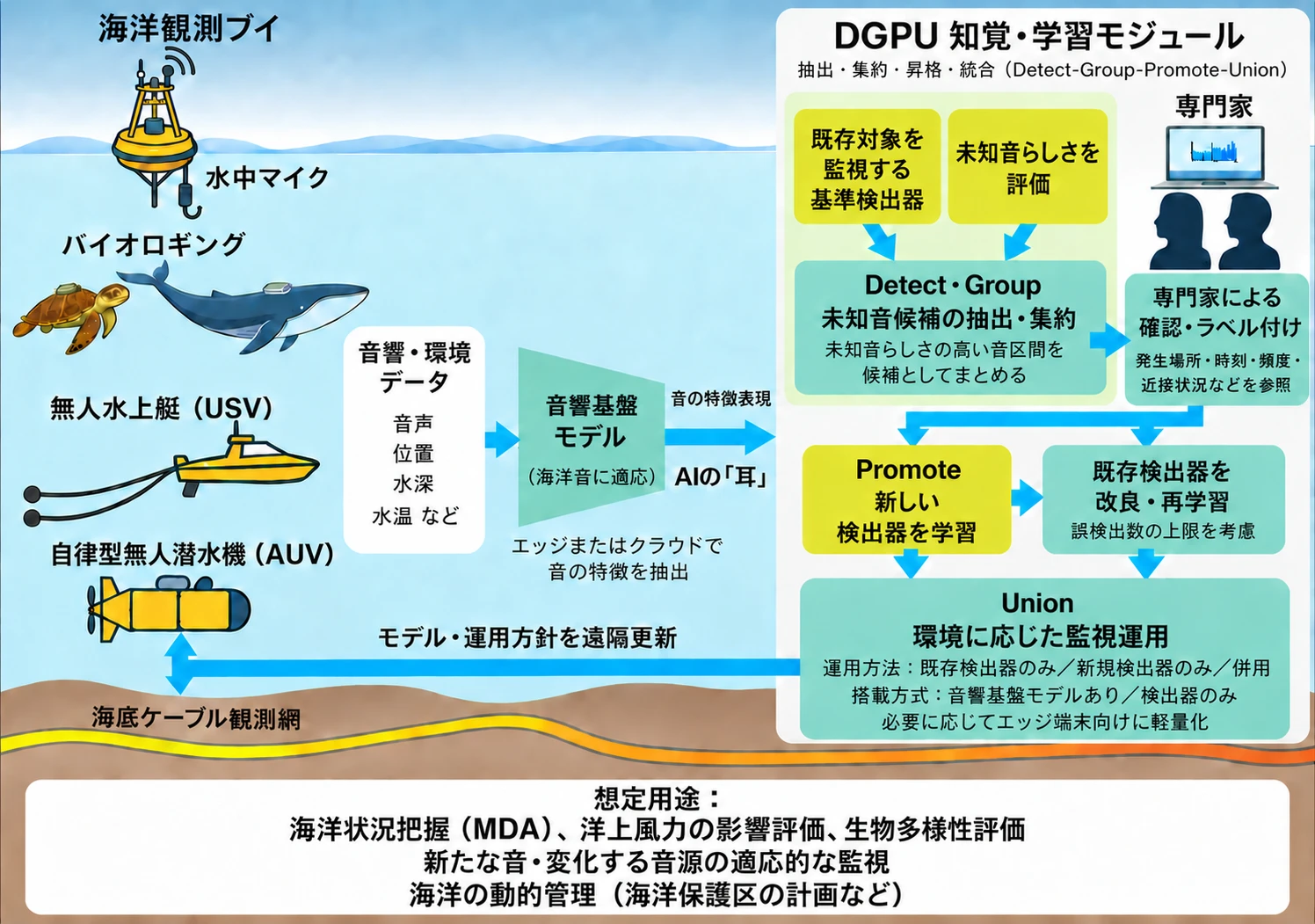
Key Points of This Research
- We expanded the system from one that detects only known sounds to one that links sounds unknown to the AI to the next observation target.
- We constructed an acoustic foundation model adapted to ocean sounds and utilized it to extract and aggregate candidate unknown sounds, as well as to train a new detector.
- We organized the entire process—from identifying unknown sounds to having them reviewed by experts and designated as new detection targets, and finally incorporating them into monitoring operations while accounting for the upper limit of false detections—as a single cycle.
- In one evaluation using existing underwater recording data, we achieved detection performance (recall) equivalent to 95% of that achieved when using all labels, using only about one-third of the labels.
In this study, we implemented and evaluated the key stages that constitute the DGPU using existing underwater recording data. Through this, we demonstrated the technical foundation for AI to continuously incorporate untrained sounds into the observation targets through expert judgment. We have filed a patent application for technologies related to the DGPU.
These research results were achieved as part of the project “Mapping Biodiversity Using Biologging Capable of Observing Underwater Soundscapes,” selected for Phase 1 of NEDO’s “SBIR Promotion Program”(Project No.: 24000810-0), as well as the subsequent Phase 2 of the Ministry of the Environment’s “Inter-Ministerial SBIR Environmental Conservation Research Grant (Research and Development Support Program for Environmental Startups to Foster Innovation)” (Project ID: 25-R-03).
Anticipated Applications
The DGPU is expected to be applied to long-term, large-scale underwater sound observations where it is difficult to define all target sounds from the outset.
- Marine Situation Awareness (MDA)
- Long-term monitoring of marine life and biodiversity
- Monitoring changes in the marine environment and sounds associated with human activities
- Environmental assessments of underwater noise and marine ecosystems in offshore wind power generation and port development
- Collection of potential unusual sounds generated by underwater facilities and equipment
- Reanalysis of large collections of underwater recordings and the search for previously overlooked acoustic events
- Research on building new detectors from limited labels for target sounds that existing detectors cannot handle
For these applications, it is crucial that AI does not determine the meaning of sounds on its own, but rather combines its analysis with the judgment of experts in each field. DGPU aims to serve as a “stethoscope for the ocean,” continuously linking acoustic AI with expert knowledge and incorporating even unknown sounds into its observations to capture changes in the ocean through sound.
Publication Information
- Paper Title: Discovery and Promotion of Unknown Sounds into Operational Detection Targets for Underwater Passive Acoustic Monitoring Under False Alarm Constraints
- Authors: Takuji Noda, Takuya Koizumi
- Journal: Scientific Reports
- Acceptance Date: September 24, 2026
- Publication Date: October 2, 2026 (published online)
- DOI: 10.1038/s41598-026-73751-w
For inquiries regarding this matter, please contact us via the Contact Us page or email contact@biologging-solutions.com (Contact: Takuji Noda).
Related Pages
Marine Acoustic Monitoring / Soundscape Visualization
This solution records and classifies underwater sounds to visualize the state of marine ecosystems. We welcome inquiries regarding collaborative research and commissioned studies in fields such as environmental surveys for offshore wind power, fisheries resource management, and biodiversity assessment.
LoggLaw NAD-W
An acoustic logger that records underwater sounds using a broadband hydrophone. It detects sounds such as dolphin clicks using cloud-based AI.