Key findings
- 1
Until now, detectors only looked for sounds decided in advance. DGPU lets sounds that are new to the AI become the next things to monitor.
- 2
We built an audio foundation model tuned to ocean sound and used it to find unknown-sound candidates, group similar sounds, and train new detectors.
- 3
It doesn't stop at finding unknown sounds. Expert review, adding new detection targets, and monitoring within a false-detection limit are put together as one loop.
- 4
In a test on existing recordings, cutting the labels to about a third still gave 95% of the detection performance (recall) we got with all of them.
Study overview
When you record the ocean for a long time with underwater microphones, you pick up all kinds of sounds: animal calls, boats, waves, rain. The ocean changes with place and season, and the same sound can come through differently depending on how it travels and what noise is around it.
It's also dark down there, and it isn't easy for people to go and see what made a sound. Only a small part of a recording can be checked for what made each sound and why, so only that part can be given the correct labels an AI learns from.
Most acoustic AI is built to find the kinds of sounds it learned beforehand. But there's no realistic way to collect every ocean sound, and every way it can sound, in advance. Sounds the AI hasn't learned, even important ones, can be missed or mistaken for something else. So we looked for a way to make the most of a few labels and still keep adding unfamiliar sounds to what we monitor.
How DGPU works
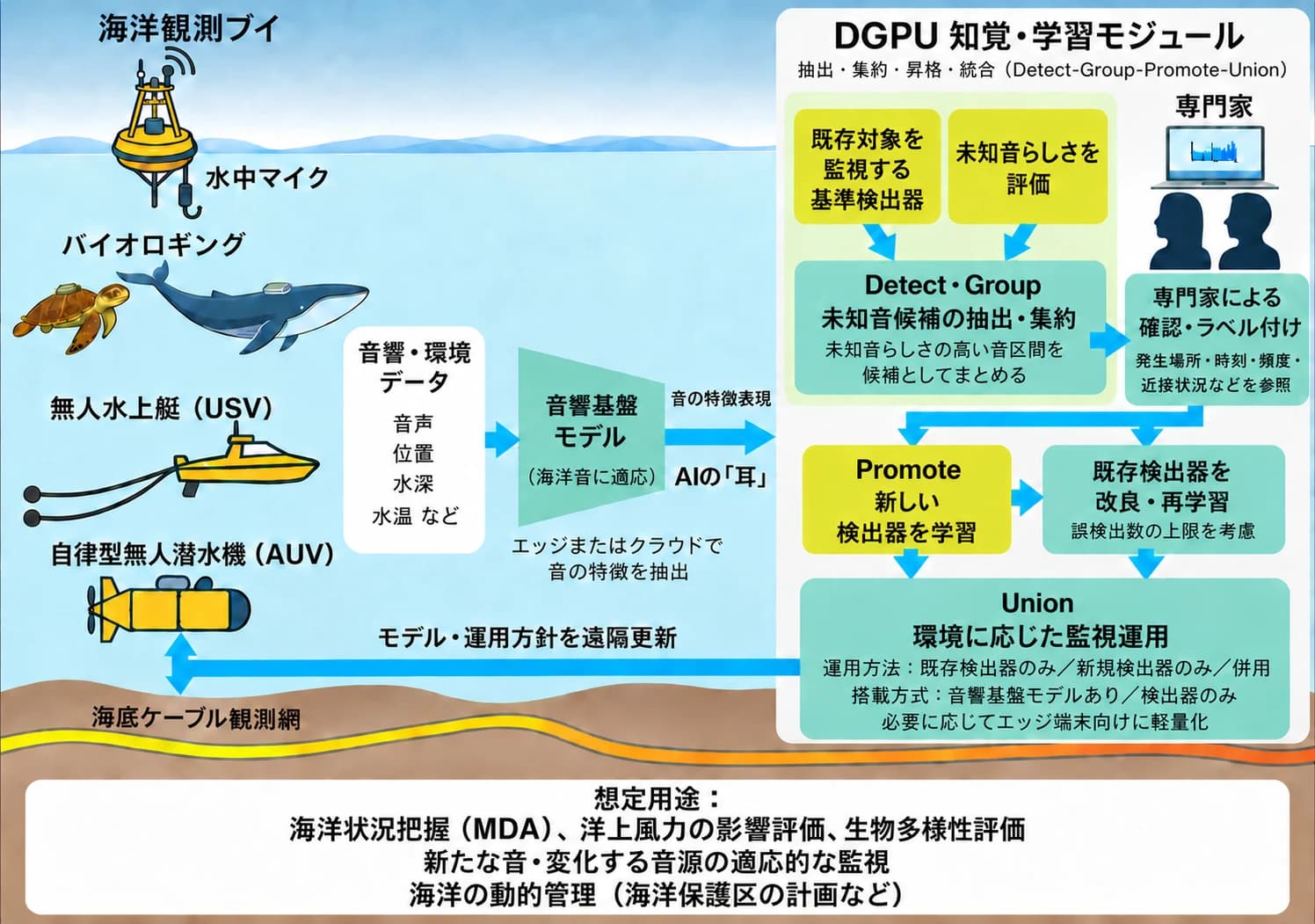
DGPU has four steps. Detect picks out candidate unknown sounds. Group puts similar sounds together. Promote turns them into new detection targets once experts have checked them. Union brings them into real monitoring. Rather than letting the AI decide what a sound is, it combines the AI's sorting with expert knowledge and grows the list of sounds we can monitor a little at a time.
Underneath is an audio foundation model: an AI that has listened to lots of sound and learned what makes sounds different or alike. This time we built one for ocean sound. From the features it picks up, it automatically flags candidates that don't match known sounds and groups similar ones together.
In long-term monitoring, the time people spend checking the AI's false detections can make or break a system. So in Union, we decide whether to use a new detector on its own or alongside existing ones, while keeping an eye on the false-detection limit. Promote builds the detector; Union gets it ready for real monitoring.
This time we put together and tested the main steps of DGPU on existing recordings. We think this lays the groundwork for continually bringing sounds the AI doesn't know into monitoring, with experts in the loop. Biologging Solutions has filed patent applications for technology related to DGPU.
Why it matters
We have in mind long-term, wide-area underwater sound monitoring, where you can't decide every target sound up front. Examples include maritime domain awareness (MDA); long-term monitoring of marine life and biodiversity; tracking changes in the marine environment and sounds from human activity; and environmental assessment of underwater noise and ecosystems for offshore wind and port development. We also have in mind collecting unusual sounds from subsea equipment, revisiting large archives of recordings, and building detectors for sounds that existing ones can't handle.
Whatever the use, it matters that the AI doesn't decide what a sound means on its own; it should work alongside experts in each field. DGPU aims to keep acoustic AI and expert knowledge connected, take in unfamiliar sounds along the way, and become a 'stethoscope for the ocean' that hears changes in the sea.
This work is part of R&D related to NEDO's SBIR Promotion Programme Phase 1 project 'Mapping biodiversity with biologging capable of underwater soundscape observation' (project no. 24000810-0) and the follow-on Phase 2 of the Ministry of the Environment's inter-ministerial SBIR Environmental Protection Research Grant (Environmental Startup R&D Support Programme for Innovation Creation; project ID 25-R-03).
Authors & collaborators
- Takuji Noda (Logverse Division, Biologging Solutions Inc.)
- Takuya Koizumi (Logverse Division, Biologging Solutions Inc.)
Source
Takuji Noda, Takuya Koizumi (2026) Discovery and promotion of unknown sounds into operational detection targets for underwater passive acoustic monitoring under false alarm constraints. Scientific Reports.
https://doi.org/10.1038/s41598-026-73751-wSupplementary materials
Related products & use cases
Marine acoustic monitoring (solution)
Our service that records and classifies underwater sound to visualize marine ecosystems, the environment and human activity. Joint research and PoC inquiries start here.
What is biologging: principles, history, applications
What animal-borne devices can measure, how they work, and the kinds of data they produce.
Related research
Digest by
A graduate of Kyoto University's Graduate School of Informatics and UC Santa Cruz's School of Environmental Studies. As co-founder of Biologging Solutions Inc., a Japan-based biologging equipment manufacturer, he oversees deployments of the company's products with municipalities, universities, and international consortia.
A biologging researcher with field experience including gyro-logger studies of penguin behavior in Antarctica. As co-founder of Biologging Solutions Inc., he leads the development of compact data loggers, GPS collars, and video loggers built directly around real-world research needs.